2019 Film Girl Film Festival Winners Announced

sisters march.jpg

The votes have been counted, and the winners of the Audience Awards for the 2019 Film Festival have been announced!

The winner for Best Film is “The Garden Left Behind.” Directed by Flavio Alves, the film follows Tina, an undocumented Mexican trans woman struggling to make a life for herself and her grandmother in New York City. More details can be found on the movie’s site here.

This year also saw the first tie, with “Grandpa’s Getaways” and “Sisters March” sharing the Audience Award for Best Short.

“Grandpa’s Getaways” tells a story of love and memory. Will has always been the hero of his own stories in spite of the fact that no one believes him. How much of it is true? And how much does it really matter? You can find more information about the film here.

“Sisters March” is a reflection on the journey between Chicago and DC, connecting voices of hope, empowerment and intersectionality during The Women's March, the largest protest in the history of the United States, as women and girls organize and rally after the inauguration of the 45th president. Focusing on intersectionality, mothers and daughters from every strata of the country reflect on the work that is to come for the women's movement and how we can mobilize for change. More details can be found here.

Thanks to everyone who voted, and to festival sponsor MKE Production Rental for providing the prize!

52 Films By Women: The Holiday (2006)

IMDB

IMDB

By Andrea Thompson

Movies about Christmas and the holiday season in general tend to be a tough sell. It's a time of year that's predicated on giving, family togetherness, and cheer, and as one of my favorite pop culture characters once said...

Screenshot

Screenshot

Screenshot

Screenshot

Most of us don't seem to want to acknowledge just how emotionally fraught the holidays can be for some. If you're estranged from your family, suffered a loss, are more of an introvert who's not fully comfortable with the continuous show of cheer the season demands, or honestly, even just single, Christmas and New Year's can be a constant, painful reminder of how well-adjusted and happy everyone else seems to be.

But the 2006 romantic comedy “The Holiday” not only gets it, it makes it the central premise. Or rather premises, since “The Holiday” gives you two rom-coms for the price of one while mostly doing justice to both. Reviewers didn't seem to agree, the main criticisms being that it was predictable and treacly. There's some truth to that, since there's never really much question of just where its central relationships are going or how they'll end. Then again, predictability is a component of many a film, and “The Holiday” isn't only an enjoyable one about the mess we can make of our love lives, it's a movie about movies as well as a tribute to the entire rom-com genre, fueled by the love writer-director Nancy Meyers clearly has for both. It's too sincere to be subversive though, and I mean that as a compliment.

Meyers was well on her way to establishing herself as a rom-com force to be reckoned with, having made “What Women Want” in 2000, and “Something's Gotta Give” in 2003, and “The Holiday” had another side effect. It solidified what has now become Meyers's trademark, that of plots which occur in chic spaces with impossibly immaculate kitchens. Much like the reviews, such criticisms of her work, one which rarely seems to stick to the men who make similar films, seems to miss the point of “The Holiday,” which actually makes not just the personal and professional differences between protagonists Iris (Kate Winslet) and Amanda (Cameron Diaz) part of the plot, but their economic ones as well.

Both women find themselves lovelorn and lonely for the holidays in perfectly symmetrical ways. Amanda is a workaholic whose relationship has just combusted, but instead of being the receiving end of a commitment-phobic guy, she is the one who is unable to get emotionally invested in any of the men she dates. She is also somewhat stunted, unable to even shed a tear after her boyfriend departs, despite her efforts. In contrast, Iris is still in love with her co-worker and ex Jasper (Rufus Sewell), despite the fact that they parted ways three years ago. Amanda may not be able to cry, but when Iris learns Jasper is engaged, she not only goes home and sobs uncontrollably, she even starts inhaling the gas in her stove, much to her shock. “Low point!” she exclaims.

The two women decide they need a change of scene, and agree online to swap houses for two weeks. Even if Iris is kind of solidly middle class with a quaint cottage in the English countryside, she's still flying to LA in a plane where she occupies a middle seat, while Amanda is ensconced in her own private area where she's free to not only stack up some books, but lie down. While Iris revels in the California sun and the luxury of her spacious, technologically advanced new digs, Amanda is quickly bored by the quiet remove of the cottage and books a flight out for the next day. Until, at least, this walks through her door...

Screenshot

Screenshot

Sure, Jude Law had his issues...but I'm superficial. Oh yeah, he plays Graham, and he's there because he's Iris's brother looking to sleep off some alcoholic overindulgence. Whatever. While these two ridiculously attractive people waste little time physically connecting that very night, their connection of course has a time limit, since Amanda is leaving in two weeks. Iris has the much more interesting story, and not just because it takes a bit more time to develop. She not only has Jack Black as Miles, who utilizes the full force of his charm as a more unconventional romantic lead who has a tendency to pick the worst possible person for him, she gets to befriend screen legend Eli Wallach, whose character Arthur is a similarly renowned screenwriter who claims to have added “kid” to the iconic “Casablanca” line “Here's looking at you, kid.” Through him, Meyers comments on the state of a film industry still partially resisting the throes of monopolization Disney now embodies, and her love of classic films, which often featured indomitable female characters that all but vanished once Hollywood's Golden Era ended.

Iris also has a far darker connection with her ex Jasper, who exhibits the kind of gaslighting toxicity that is chillingly familiar. The fact that they work together at the same paper makes it complicated for Iris to extricate herself from him, but Jasper effortlessly oozes charms as the kind of so-called nice guy who is popular in the office. He's also a talented writer who is skilled at keeping Iris emotionally hooked while ensuring it's all about him, complimenting her professional skills and asking her to go over his pages. Because he respects her opinion of course. While we might be inclined to roll our eyes at the beginning of the movie, where Iris says she knows Jasper will never love her back but can't help loving him anyway, their subsequent interactions soon reveal everything about why she feels like she needs to literally flee the country in order to escape their dynamic.

Cameron Diaz might not get nearly as much to work with, but she gets to stretch her comedic muscles a bit when she stumbles her way to the cottage in heels, and her profession of cutting movie trailers is used to more playfully toy with rom-com tropes. Throughout, Amanda gets mocking commentary from...herself, as various trailers about her life play in her head at odd moments. Thankfully, her repression is also not summed up as a simple case of Overworked Woman In Need Of A Man Syndrome, but family dynamics. Amanda's family seemed to be close-knit and loving, right up until she found out her parents were getting divorced when she was 15. Afterwards, she found herself unable to cry. Amanda is using work to avoid love, and when she discovers that Graham is actually a widowed father to two girls, his reasons behind keeping his dating and family life separate sounds like he's using fatherhood much the same way.

Sure, we all know where this is going, but goddamn is it fun, even if you're not a cinephile. How many of us have used movies and pop culture to better understand our own lives? It'd be difficult to find someone who hasn't. So when Eli Wallach tells Iris she's a leading lady who's acting like a best friend, she replies, “I've been going to a therapist for three years, and she's never explained anything to me that well.” Iris doesn't just connect with a love interest in Miles, she forms a new friendship with Arthur, and his movie recommendations, all of which featuring complex female leads, probably play a role in Iris finally cutting Jasper out of her life. Her joy at the realization of her power and that she now has her whole life ahead of her is a genuine, well, joy to watch.

The happy ending, where both couples celebrate the new year in Iris's cottage with Graham's daughters, is rather jarring at first, since nearly everyone but Iris and Amanda have met each other in spite of the impact they've had on each other's lives. Their story may not have inspired much love at the time, but “The Holiday” only seems to have become more popular since as a beloved holiday staple.

52 Films By Women: Portrait of a Lady on Fire (2019)

IMDB

IMDB

By Andrea Thompson

Watching the passionate 18th century French romance “Portrait of a Lady on Fire” is an experience, and not just because it's such a beautifully told love story. Since it also happens to be a love story between two women, it's going to be about far more than the lovers themselves, and sure enough, “Portrait” is both an indicator of how far we've come, and how far we have yet to go. However, the film not only seems aware of this, it's pretty damn intent on charting its own course, and to hell with the male gaze and all the expectations thereof, with none of their love scenes even shown on-screen.

Even juicier is the fact that writer-director Céline Sciamma previously dated Adèle Haenel, one half of the couple her film breathtakingly portrays. Sciamma certainly shrouds the noblewoman she plays, Héloïse, in mystery, revealing various faceless portraits of her far before she reveals the woman herself, even shrouding her in a cape before she joyously bursts onto the screen on a sumptuous scene set on the cliffs overlooking the sea on her isolated estate.

Observing her is Marianne (Noémie Merlant), who has been hired to paint Héloïse's portrait for her upcoming marriage to a Milan nobleman, which will occur once the painting is finished. Héloïse is opposed to the nuptials, so she has refused to sit for it, and she's unaware that the young woman she believes has been hired as a walking companion has actually been tasked with closely observing her so she can finish the portrait, which will allow the marriage Héloïse dreads to take place.

portrait posing.jpg

It's a sad fact that films with protagonists other than white men will inevitably be compared to each other. Case in point: how many of us compared “Captain Marvel” to “Wonder Woman” when it came out, even though “Wonder Woman” was released two years prior? I know I certainly couldn't resist, despite my best efforts. So I hope I'll be forgiven for “The Handmaiden” being at the forefront of my mind during the first half of “Portrait of a Lady on Fire.” Both kick off a love story between two women based on deception, although “Portrait” is more heartbreaking. Héloïse believes Marianne's glances are due to passion alone, but Marianne is part of the forces slowly closing in, and she must hide her true profession, and all the evidence of it, such as the work itself, and the clothes and hands spattered with paint.

Héloïse in essence begins as a silenced woman, a traditionally passive muse whose future has been decided, although the artist portraying her has a more direct role in that future than usual. This silencing, this forced passivity that is a direct result of the patriarchal world all the women on-screen cope with in various ways, is what “Portrait” really delves into, and the wrenching vulnerability, as well as the power, of seeing while being seen. After Marianne reveals her true purpose, she is startled and unsettled when she realizes her seemingly unaware subject has been closely observing her too.

Héloïse quickly becomes an active partner in Marianne's creation, especially when Héloïse's mother (Valeria Golino) departs for a few days. Not only Héloïse and Marianne, but Sophie (Luàna Bajrami), the maid they also befriend, are free to create their own matriarchal world...and help Sophie get an abortion. All three women bond, but it's also clear who's falling for whom. Héloïse not only encourages Marianne not to look away from Sophie's procedure, she is the one who decides that it's a worthwhile subject to paint. For Sciamma, women's art and their lives aren't just worthwhile subjects that have been neglected, they're part of a history that's still barely acknowledged today, as hashtags such as #shoutyourabortion prove.

Screenshot

Screenshot

Marianne is the one who has the ultimate luxury, that of a choice. It shapes her life and how she responds to the world. Sciamma emphasizes her independence from the start, as she jumps off the boat bringing her to the estate to rescue some of her equipment and carries it in herself rather than depending on the men conveying. She is also the one who takes the male role in the much-discussed story of Orpheus and Eurydice when the three women ponder why Orpheus looked back at his wife Eurydice at the last minute, dooming the lovers to part ways as Eurydice is dragged back into the underworld. Marianne suggests that perhaps Orpheus chose the memory of her rather than Eurydice herself. “He doesn't make the lover's choice, but the poet's,” Marianne says. “Perhaps she was the one who said, 'Turn around.'”

That might indeed have been the case, but actively choosing to part ways is not an option for either lover in this case, who never even discuss the possibility of a future together. When the inevitable parting does indeed come, and Marianne sees a vision of Héloïse in her wedding dress telling her to turn around, it feels like a coping mechanism, an illusion of choice in a situation where there isn't one. Men may only have cameo roles in “Portrait of a Lady on Fire,” but this is nevertheless their world, and there's no place for a love like the one Marianne and Héloïse passionately share. Even Héloïse's mother, who knows the pain her daughter is feeling, is nevertheless willing to give her daughter to a stranger, simply because she can't imagine any other path for her.

However, their bond lives on, and Héloïse goes on to play an active role not only in Marianne's art, but in the art others create, even if in some cases it's only visible to those who know how to look. When Marianne sees her for the last time, it's also when Héloïse is at a concert, where she passionately reacts to music she heard for the first time when Marianne played it for her. Both may be alone, but they will remain connected for the rest of their lives.

52 Films By Women: Guinevere (1999)

Screenshot

Screenshot

By Andrea Thompson

The story “Guinevere” tells has been done to death, hasn't it? I mean, don't we all know how it goes? An innocent young ingenue forms a relationship with a much older man, and she becomes his muse while also being mentored by him, which allows her to blossom creatively as well.

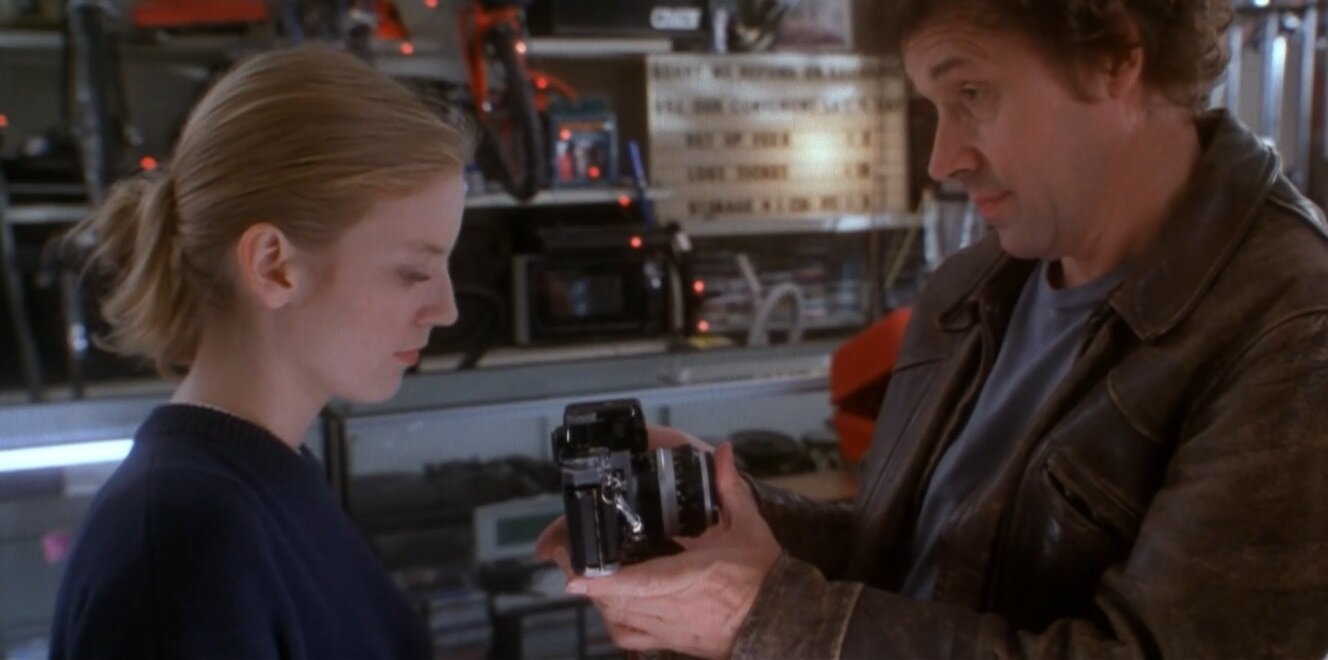
Yet to watch “Guinevere” is to see far more. It's partly due to writer and director Audrey Wells, who was still in the beginning of her career when she made her directorial debut with this film in 1999. But the main one is probably lead Sarah Polley, who is remarkable as 21-year-old Harper Sloane, who meets the much older bohemian photographer Connie (Stephen Rea) at her sister's wedding.

Actually, Connie notices Harper far before he approaches her, snapping a photo of the awkward young woman as she's doing her best to appear anything but. She's a daughter of privilege who is bound for Harvard, per the expectations of her family, who are part of a long tradition of legal sharks. Privilege may be wasted on the privileged, but once Harper follows Connie into his world, which is populated by a vast array of artists, the conservative atmosphere of her family life becomes more stifling than ever.

Screenshot

Screenshot

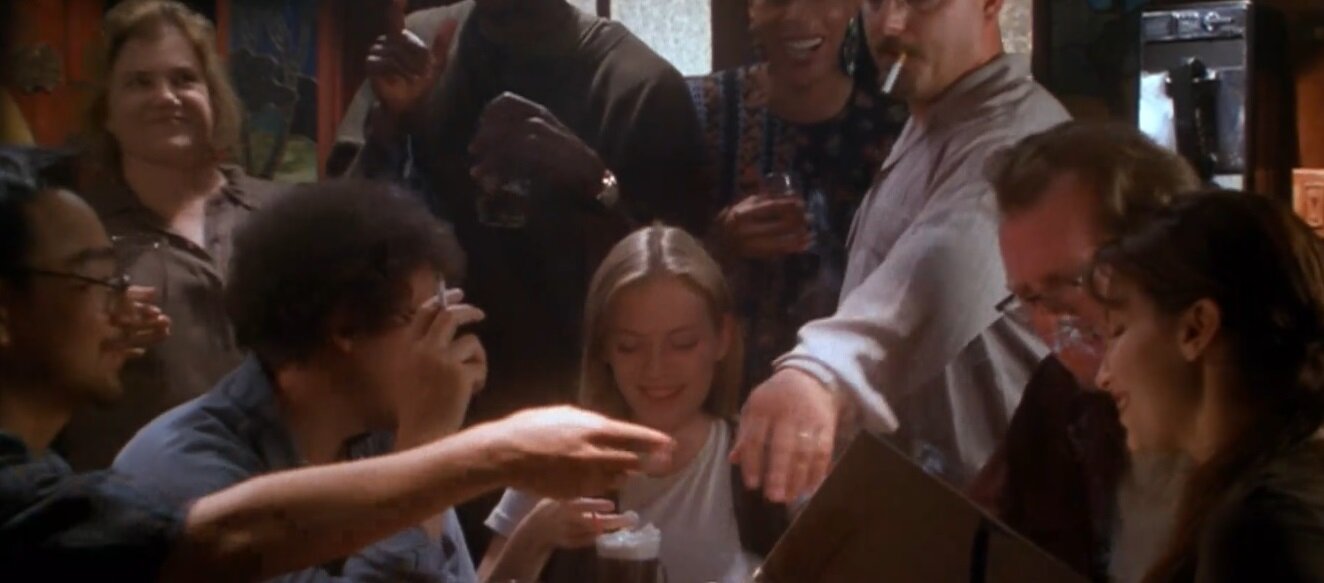
Connie also constantly asks Harper for her opinion, firmly believes she has the potential to be a great artist, and insists on sleeping on the floor of his darkroom when she spends the night in his loft. So when Harper tries to insist Connie is too old for her, her friend Patty (Carrie Preston) knows better, and so do we. The affair they quickly start is a given, as are the difficulties inherent in it. Harper attempts to retreat back to her family, but since Connie is the only entry point for a more free-spirited environment she doesn't have the confidence or connections to explore on her own, she quickly returns to him when he shows up asking for her forgiveness. That he also manages to throw her a killer 21st birthday party is the kicker.

By then, both we and Harper are aware she is one in a long line of young women Connie has dated, all of whom he refers to as Guinevere. But he also genuinely tries to help them, insisting that they work, which to him means studying, learning, and creating, whether it happens to be through photography, writing, painting, or some other artistic endeavor. Connie desperately wants to be honest, but his deceptions are unavoidable due to the fact that he's just as desperate to believe he's not the same as, say, another older man who gives him a smirking thumbs up while he's sitting with a much younger blonde. It's even worse than other reactions the two of them tend to inspire, which can be summed up as variations of an eye-roll.

But it's Harper's mother Deborah (Jean Smart) who best sums up the dynamic between Connie and Harper while revealing herself to to be a society bitch in the best way. And goddamn, Jean Smart makes the most out of this small role. She had been unaware that her daughter was living with Connie, and once she finds out, she has no problem letting her feelings be known to them both. Not only does she ask Connie outright what he has against women his own age, she refuses to let him bullshit his way out of the answer. She also knows that his preference for the barely legal is due to far more than just their bodies, even if that's the easy answer.

Screenshot

Screenshot

“I know exactly what she has that I haven't got,” Deborah says to Connie as she smokes her cigarette so stylishly it should be impossible. “Awe. That's it, isn't it? I mean, no real woman – no woman of experience, would ever stand in front of you with awe in her eyes...and say, 'Wow, look at that man. Look at that bohemian wedding photographer with holes in his jeans. Gosh, isn't he something?' No. It takes a naive girl for that. It takes Harper for that.” So effective is Smart's delivery that her character had the honor of being called not just a nasty woman, but a “terribly nasty” one by an LA Times critic, even as he acknowledged how right she was.

Harper's feelings are more complicated four years after she and Connie part ways, by which time she has become a successful photographer and he is dying from complications related to alcoholism. “He was the worst man I ever met,” she recalls. “Or maybe the best. I'm still not sure. If you're supposed to learn from your mistakes, then he was the best mistake I ever made. He was my most spectacular, and cherished fuckup.” Their relationship hurts her as much as it helps her, and her reaction is an example of one of the many ways women must forgive for the sake of their sanity. So often, this is how young women are initiated into fields which are dominated by men, who are often just as intent on satisfying their own desires as they are in assisting the vulnerable young women who happen to stumble across their path.

However, “Guinevere” acknowledges another truth, on how ultimately unsatisfying it often is for the other side of the equation – the men who do the exploiting. Connie may repeatedly get a pass to behave this way over and over again, but it leaves him unhappy and ultimately less successful. As he nears his end, he certainly gets more support than he deserves, from not just Harper, but the other women from his past who return, which include the likes of Gina Gershon and Sandra Oh, and of course, his latest bright young thing, April (Grace Una).

Screenshot

Screenshot

Even as Harper informs the dying Connie just how much it took for her to get to a point where she could return to his side, something which wouldn't have been possible for her two or even one years ago, she is willing to give Connie a vision of his own personal heaven. In her imagination, as Connie goes down an astonishingly bright hallway, he is treated to the presence of the various women from his past, who all making individual appearances as he glides onward. At the end, a 19-year-old with a camera awaits. As she takes his picture, the flash goes off with the brightest, purest light he's ever seen. And that will be all, because in the end, what more could a man like Connie want?

52 Films By Women: Strange Days (1995)

IMDB

IMDB

By Andrea Thompson

Some filmmakers, even the well-known ones, are full of surprises. Take Kathryn Bigelow, who has been directing for decades, but is mostly known for her later work, such as “The Hurt Locker,” “Zero Dark Thirty,” and “Detroit.” I've already covered another of her lesser-known films, “Near Dark,” but “Strange Days” is even more unfamiliar. It's also most likely the most ambitious film Bigelow has ever made.

It has a few things in common with with “Near Dark” in that it's a blending of genres, although “Strange Days” was such a flop it nearly ended Bigelow's career. Where “Near Dark” was a masterpiece which blended the vampire movie with the western, “Strange Days” is even more unusual, a sci-fi neo-noir which takes place in a bleakly dystopian 1999 Los Angeles, a mere four years after the film was made in 1995.

In Bigelow's vision, the riots which the city apart in 1992 after the Rodney King verdict never really ceased, but became a pattern of violent social unrest, transforming Los Angeles into a war zone. Not that it seems to really bother Lenny (Ralph Fiennes), a dealer who feeds on the disillusionment of the populace to sell his very illegal wares, which is where “Strange Days” really gets prescient. People can fit themselves with recording devices they attach to their head, which allows them to record not only their experiences, but their emotions and sensations. The resulting videos, which can range from pornography to, in one case, a robbery, are in high demand, and Lenny is happy to provide them to his customers. For a hefty fee of course.

IMDB

IMDB

Lenny is also an ex-cop and an addict of the drugs he’s peddling, frequently retreating into footage of his past relationship with singer Faith Justin (Juliette Lewis), who has long since left him for sleazy music industry mogul Philo (Michael Wincott). Lenny doesn't need much of an excuse to want to get Faith away from her new beau, but he has more reason than usual after Faith's former friend Iris (Brigitte Bako) comes to Lenny with a desperate plea for help. Faith is clearly caught up in something, but insists to Lenny that their relationship is over and she doesn't need rescuing. Lenny thinks otherwise, and when he receives a recording of Iris being raped and murdered, he decides to dig deeper.

From a modern perspective, much of the recordings in “Strange Days” look like either YouTube videos or first-person shooters. And much like today, the fact that so many people have recording devices meant that people who were previously deprived of a voice could hold the powerful accountable. Race isn't often addressed in noir or sci-fi, but it's one of the central themes of “Strange Days,” as much of the unrest springs from inequality, specifically a system that dehumanizes much of its citizenry.

Even if most of the characters are white, the concerns of black people and the racism they face is what fuels “Strange Days.” But they're really embodied in Angela Bassett's badass performance as Mace, a limo driver who also becomes Lenny's bodyguard throughout their investigation. She and Lenny met when he was still a cop, the day Mace's former partner was arrested for dealing, and she found her son in his room with Lenny, who effectively shielded him from the trauma of watching his father get carted off to jail. But where Lenny encountered heartbreak and only made himself more vulnerable, Mace responded to her difficulties by making herself stronger. This is a pattern that repeats throughout the film, with Lenny often depicted as vulnerable, while Mace is the one who repeatedly fights off both her and Lenny's attackers, even if they often just barely escape with their lives.

IMDB

IMDB

What their pursuers are willing to kill for turns out to be footage of two police officers murdering the Tupac-esque rapper Jeriko One (Glenn Plummer) at a random traffic stop. Mace wants to release the footage to the media, but as several characters point out, such an action could make their already turbulent city explode into an orgy of violence. It's an excellent point, but this environment, which is an almost laughably Mad Max vision of a city on the verge of the apocalypse. is also what makes “Strange Days” so cringey at some points. It's a 90s vision of edginess, with music that would barely appeal in its own decade, what with its annoying combination of the era's grunge, rock, and punk aesthetic. People just thought they were so dark and edgy in the 90s.

That's about the only part of the film which really feels dated, as the movie's flaws are more than compensated by the absolutely terrific performances and Bigelow's skillful direction. Ralph Fiennes has flexed his comedic muscles in films such as “Hail Caesar!” and “The Grand Budapest Hotel,” but he's mostly become known for his more serious work. In “Strange Days,” Fiennes is hilariously appealing as the weaselly, yet charming Lenny, and we have no problem rooting for him. And while Bassett is incredible in her supporting role as the film's moral center who isn't willing to compromise her ideals and bargain away a tape that could change things, Juliette Lewis might just be the one who accomplishes the most. Faith could've easily been another objectified damsel, but Lewis gives her real heart as a woman so desperate to sate her desires that she's willing to put her life and sanity in the hands of a man who's as paranoid as he is abusive, only realizing the true gravity of her situation until it's too late for her to escape unscathed.

It's really Bigelow, however, who makes all the difference. “Strange Days” features quite a few recordings that feature violence, rape, and murder, but she never glorifies the horrors on display. During the robbery, we share in every bit of the victims' fear as armed men burst in on them with guns, then the horror and panic as thing going south. Crucially, the rape scenes are brutal, but not graphic. We feel the pain of the women who are not only violated, but also made to see what their attacker sees, in essence witnessing their own assault and murder through his eyes.

IMDB

IMDB

With so much unrelenting darkness, you'd think that the hope Bigelow offers at the end would feel hollow. But she surprisingly makes a damn good case that maybe, just maybe, things could be different in the new millennium. After so much brutality, the year 2000 actually kicks off with a high-ranking law enforcement official doing the right thing, a black woman being believed, and the police actually serving and protecting. Even if it feels like we've regressed in many ways, at least we seem to be confronting the many themes “Strange Days” addressed far before #MeToo, Time's Up, and Black Lives Matter forced such difficult discussions into the mainstream.

52 Films By Women: Death is a Caress (1949)

IMDB

IMDB

By Andrea Thompson

It's still Noirvember, and I wanted to mark the occasion with another noir film directed by a woman. Having discussed Ida Lupino's “Outrage” last week, my options were predictably limited. Lupino was practically the only female director working in Hollywood at the time, and breaking it down by the genre made pickings far slimmer if I wanted to focus on a film by a different director.

But bless this wonderful age we live in, where there's always something somewhere that will reference the more obscure titles even some of the most devoted cinephiles haven't heard of. That, in short, is how I came across “Death is a Caress.” Made in 1949, it was apparently the first Norwegian film directed by a woman, and it upends many of the typical noir staples.

filmlinc.org

filmlinc.org

The film is narrated via flashback, beginning as a police vehicle drives through the streets. Ah siren, siren, what crime brings you forth? This is how we meet Erik (Claus Wiese), the young man under arrest who proceeds to narrate the film via flashback to his lawyer. Before his troubles started, he was a successful mechanic who was engaged to a beautifully innocent, adoring young woman named Marit (Eva Bergh). In true noir fashion, the best you can say about her is that she's delightfully bland. During one of their interactions, the camera zooms in a lovely white ornament nearby, as if to dangle the possibility of a happy, pristine future that's not to be.

Needless to say, Sonja (Bjørg Riiser-Larsen ) fits neatly into the mold of the femme fatale from the minute she appears. She's not only married, she's older and in full possession of wealth all her own, having never needed a man to support her. She's beautiful, but it's in a different fashion than noir dames typically are, with the sheer force of her presence being a large component of the impression she makes. When she shows up, she strides right over to Erik and demands his attention on their first encounter, and nearly runs him over in the next.

As their seductive dance continues, Erik tries to resist it, take solace in Marit, and avoid Sonja, only to be drawn back to her more and more willingly. Even when he meets Sonja's oblivious husband, Erik and Sonja exchange the kind of knowing smirks and glances that can only mean one thing as their interactions become more and more charged, and Erik soon abandons Marit without looking back. When he and Sonja do finally consummate their mutual attraction, it's far more erotic due to the lack of interference from the Hays Code, even if it's far less graphic than the films of today.

elgabinetedeldoctormabuse.com

elgabinetedeldoctormabuse.com

Surprisingly, Erik and Sonja's relationship soon incorporates love as well as lust, although Sonja has clearly formed similar liaisons previously. Sonja even promises Erik to divorce her husband and marry him. Even more shocking is that after an initial hesitation, Sonja actually follows through. But her and Erik's interactions have always been laced with harbingers of doom, and the problems start to arise as early as their honeymoon, and continue to grow throughout their relationship, which becomes more and more turbulent. Erik is somewhat resentful of Sonja's money and position, and she becomes more and more jealous and suspicious of him. Yet they always return to each other, until finally their mutually destructive impulses culminate in a horrifying climax.

This kind of toxic relationship is all too familiar, especially when it comes Erik's fatalistic mindset, which justifies his inability to take responsibility for his actions. He regrets what he's done, yet he believes it was inevitable, albeit in a more complex fashion than usual. As he puts it, things aren't decided in advance, but people have to follow their path, even if he allows that our choices are affected by our experiences. Granted, it's easy to trace the roots of this belief, since even Erik's boss remarks that they're one day closer to death at the end of the workday. Is all Nordic cinema obligated to somehow reference and/or grapple with death and existential angst in general?

Erik says he doesn't blame Sonja, but rather the class differences that kept them at odds. To the movie's credit, class itself is the source of much of the film's commentary on how many restrictions women face in their public and private lives, even when they seem to have a dizzying number of options. Yet at his sentencing, Erik seems determined to assign much of the blame to Sonja, not only claiming he never would've been a killer if he hadn't met her, but that Sonja actually participated in her own killing. He is unable to accept that he deserves to punished. And the system seems to partially agree, since Erik gets a mere five years for his crimes. Rather than vanishing, one could argue that this trope has merely evolved, with powerful women often being depicted as unstable at best, and still have a tendency to perish in the arms of the same men who profess their love for them.

Screenshot

Screenshot

Screenshot

Screenshot

The movie's title becomes an indictment, unintentional or not, about how common this kind of brutality is, especially for the women who typically suffer the worst of the consequences. In every statistic, the rates for those who have experienced intimate partner violence are not only higher for women than men, but the CDC estimates that “nearly half of female homicide victims in the U.S. are killed by a current or former male intimate partner.” There's a lot of insight into a certain kind of toxicity that fuels many a vicious cycle. Like many co-dependent couples, the highs were dizzying, but the lows were also devastating.

As for Erik himself, his obsession with Sonja is still powerful enough that he seems perfectly capable of giving himself the life sentence his judges will not. By the end, sitting alone in the darkness of his cell while bathed in warm light from the nearby window, he first speaks into an unseen distance, then unsettlingly, directly to us as he says he still can't say he would've avoided her Sonja even if he knew how his time with her would end. He's still filled with a longing for not only her, but “a heaven or hell where they could meet again.”

52 Films By Women: Outrage (1950)

IMDB

IMDB

By Andrea Thompson

If you want a female director to celebrate for #Noirvember, Ida Lupino is pretty much the go to. She wasn't just the main female director working at a time when noir films were at their height, she was pretty much the only one. And while her other films such as “The Hitch-Hiker” are far more well-known, it's the underseen “Outrage” that feels as disturbingly relevant now as when it was made in 1950.

Its beginning is a common one for noir, with a woman alternately staggering and running through a lonely street at night. She's clearly been through the ringer, and we immediately wonder what she's trying to escape. A pursuer? Is this the aftermath of a terrible crime? Or is she suffering from something more existential, like the past she thought she left behind? Is she a woman on the wrong side of the law, a player who got outplayed? Did she set a plan in motion that spun out of her control?

Turns out it's something simultaneously far simpler and complex. Ann Walton (Mala Powers) isn't a noir dame who walked into a bar with a plan and eye for her next mark. She's a happy, ordinary young woman with a loving fiance, Jim (Robert Clarke) a supportive, close-knit family, and a steady job with coworkers she likes and gets along with. Even the guy who serves food at the counter and frequently gives her attention she doesn't want doesn't disturb her. What “Outrage” does as it follows Ann's struggles is offer up a critique for something the film didn't have the words for, and were prevented from even naming, what we now call rape culture.

Screenshot

Screenshot

Because that creepy counter guy that Ann barely notices follows her home one night when she's working late and rapes her. Not that the movie is allowed to say it, instead using using the word assault or attack to describe the horrifying sequence where Ann's unnamed rapist follows her throughout the dark, deserted streets as she desperately tries to call for help from various sources while attempting to evade him. When she collapses from running, the final tragic accident is a car horn which covers her implied screams, as well as a man who hears the horn but unable to see what is happening from his angle.

When Ann returns home disheveled, “Outrage” chooses empathy rather than revenge, as not only Ann but her family grapples with the aftermath of her attack. In “Lucky,” the memoir of her own rape, author Alice Sebold wrote how she learned that, “no one – females included – knew what to do with a rape victim,” and even Ann's loving parents are unsure of what to say to their daughter.

Nor does their community. How everyone learns of Ann's rape is left unsaid, but it's made very clear that they do. The students in Ann's father's class and the other teachers stare at him. More disturbing is how men try to be well-meaning and kind, patting her comfortingly, but the women mostly keep their distance as they stare and whisper. No wonder that when Ann attempts to go back to work, small noises quickly overwhelm her. After such silence, even the softest sounds are deafening to her, and the film doesn't so much as portray her mindset but embed us in it as we share Ann's pain and deterioration.

IMDB

IMDB

The situation with her fiance also doesn't help. Jim still wants to marry Ann, but only on his terms. When he says he wants to tie the knot the upcoming weekend, she stares at him with a repulsion and horror modern audiences may not be able to fully grasp. Marriage didn't just mean sex, it meant a husband could legally demand it anytime he wished, marital rape not yet being illegal. When Ann refuses, Jim shakes her and tells her to shut up. She responds, “I don't want to get married, ever. I don't want you to touch me. Everything's dirty, filthy and dirty.” Shortly thereafter, she runs away from home and finds herself on an orange picking farm.

In “Outrage,” it isn't only Ann's rapist who feels he has a right to her body. Every man in the film is entitled is his own way, even the saintly Rev. Bruce Ferguson (Tod Andrews), who takes Ann in and helps her get work as a bookkeeper on the farm. But when's Ann's past rears its ugly head, he only takes her side up to a point. At a dance, a man comes up and keeps following Ann, touching her, and insisting after she repeatedly says no. It brings up memories of her trauma, so Ann hits him with a wrench, severely injuring him. But since he has a reputation as a good guy, he's given a pass for his creepy behavior and it's Ann who is blamed. Bruce never even asks if the man made her uncomfortable, even if he's eventually able to understand and empathize with her actions.

As Ann awaits judgment, she murmurs, “Maybe I am crazy. Sometimes I feel as if the whole world is upside down.” Even if “Outrage” can't quite fully grasp what exactly makes her world seem so backwards, it can hardly be faulted for failing to realize something we're still struggling to understand today. At least the film urges reform rather than punishment, not just for Ann, but for the man who raped her, who was caught and revealed to have spent half his life in reform schools and prisons without being identified or treated as a “sick individual.” Through Bruce, “Outrage” ends up advocating not just for compassion, but for more hospitals and clinics rather than prisons.

IMDB

IMDB

As a result, Ann is not charged, but rather ordered to undergo outpatient treatment rather than sentenced to imprisonment or institutionalization. At Bruce's encouragement, she eventually stops running and goes back to the life she left behind. As she departs, “Outrage” optimistically imagines a happy future for Ann, one that is not defined by the trauma she endured. Even if it seems a bit too bright of an ending, it's one that's well-earned, and more than other movies seem to expect from women who have similar experiences.

52 Films By Women: Revenge (2017)

Film Affinity

Film Affinity

By Andrea Thompson

They say hell is other people, and in the 2017 French film “Revenge,” a young woman is certainly put through the ringer, not just because of the men around her, but their toxic entitlement that views her as an object to be used and discarded at will.

However, “Revenge” isn't just a melding of genres, an action thriller that's also a horror film. It's clearly a rape revenge movie, a horror subgenre that doesn't get a lot of respect, and rightly so. Typically, they're films that claim to be about empowering women after a devastating attack, but more often than not, they're exploitative in the most unenjoyable way, relishing women's pain and not just the violence they inflict, but also endure. Such films also tend to enforce gender norms, typically depicting a stereotypically innocent girl or woman who is “tainted” by her rape and must be avenged. Sometimes it isn't even her who does the avenging, but her family, as was the case in “The Last House on the Left” and “Death Wish.”

Given such staples, it's hardly a surprise that nearly every film in the genre was written and directed by men. Even if “Revenge” contains all the typical elements, its female gaze makes all the difference. Coralie Fargeat wrote as well as directed the film, and the longer you watch “Revenge” the clearer her intentions become. Much like a film we previously discussed, “Revenge” caters to the male gaze, but Fargeat has far more success subverting it.

IMDB

IMDB

The heroine, Jen (Matilda Anna Ingrid Lutz) isn't just an atypical heroine, she's the girl who's more likely to be killed off as punishment for her sexual sins. From the minute she appears in all her blonde glory, sucking on lollipop and then going down on her handsome blonde lover Richard (Kevin Janssens), in his gorgeous, isolated desert home he uses as a getaway for himself and his friends' hunting trips, she seems doomed, with nearly every thought emphasizing her beauty and sexuality.

How doomed becomes clear once Richard's friends Stan (Vincent Colombe) and Dimitri (Guillaume Bouchede) join them early, much to Richard's dismay. From the beginning, they unsettle Jen, but she makes the best of it, and they party late into the night. In films such as “Straw Dogs,” Jen's deeply sexual dance would be a provocation, but in “Revenge,” it's just a party, and in no way an excuse for what occurs the next morning when Richard departs on an errand for a few hours.

Even if they've never been through such an attack, so many women can relate to what happens to Jen, and the discomfort she immediately feels sitting across the table from Stan. At first she's able to laugh off the unnecessary touching and the comments. Then his leering intensity, which Jen tries to ignore, makes her so uncomfortable she retreats to her room. Stan follows her, then gets angrier when Jen doesn't respond to his advances, which she first tries to placate, then flee from. It's to no avail, as Stan not only rapes her, but is abetted by Dimitri, who not only walks away, but turns on the TV to drown Jen's screams.

IMDB

IMDB

Far from reveling in the attack, Fargeat refuses to show it or Stan himself, with the few shots emphasizing Jen's pain and refusing to consider it in any way justified. When Richard returns, his concern is keeping Jen quiet, and offers her a large sum of money as well as a job in Canada as a bribe. Jen is unsurprisingly less than receptive, only wanting to return home, and their argument escalates in Richard pushing her off a cliff, something which shocks even Stan.

Jen doesn't so much survive as experience a kind of rebirth, just barely able to at first evade the men who intend to finish the job Richard started once they discover she's alive. At first, Jen is little more than a wounded animal, but she needs no persuasion to do away with Dimitri, the first man who finds her. After that first kill, she spends the night healing herself thanks to a drug and some methods that don't seem like they'd be effective enough to allow her to walk, let alone run and fight, the next day. But in case we missed the point “Revenge” has been trying to make, the phoenix from the bar can Jen used to cauterize her wounds has become magnificently branded onto her skin. With such flourishes, who really cares about plot holes?

Sure enough, when Jen spots Stan, she runs toward him, not away. Is Jen objectified, even though she's become the hunter, rather than the hunted? To be sure. This is still an exploitation pic where a devastatingly attractive young woman woman is wreaking havoc in skimpy clothes. But Jen's scars are also her glory, adding to her new identity as a hawk-like avenging angel who tears her prey to shreds.

IMDB

IMDB

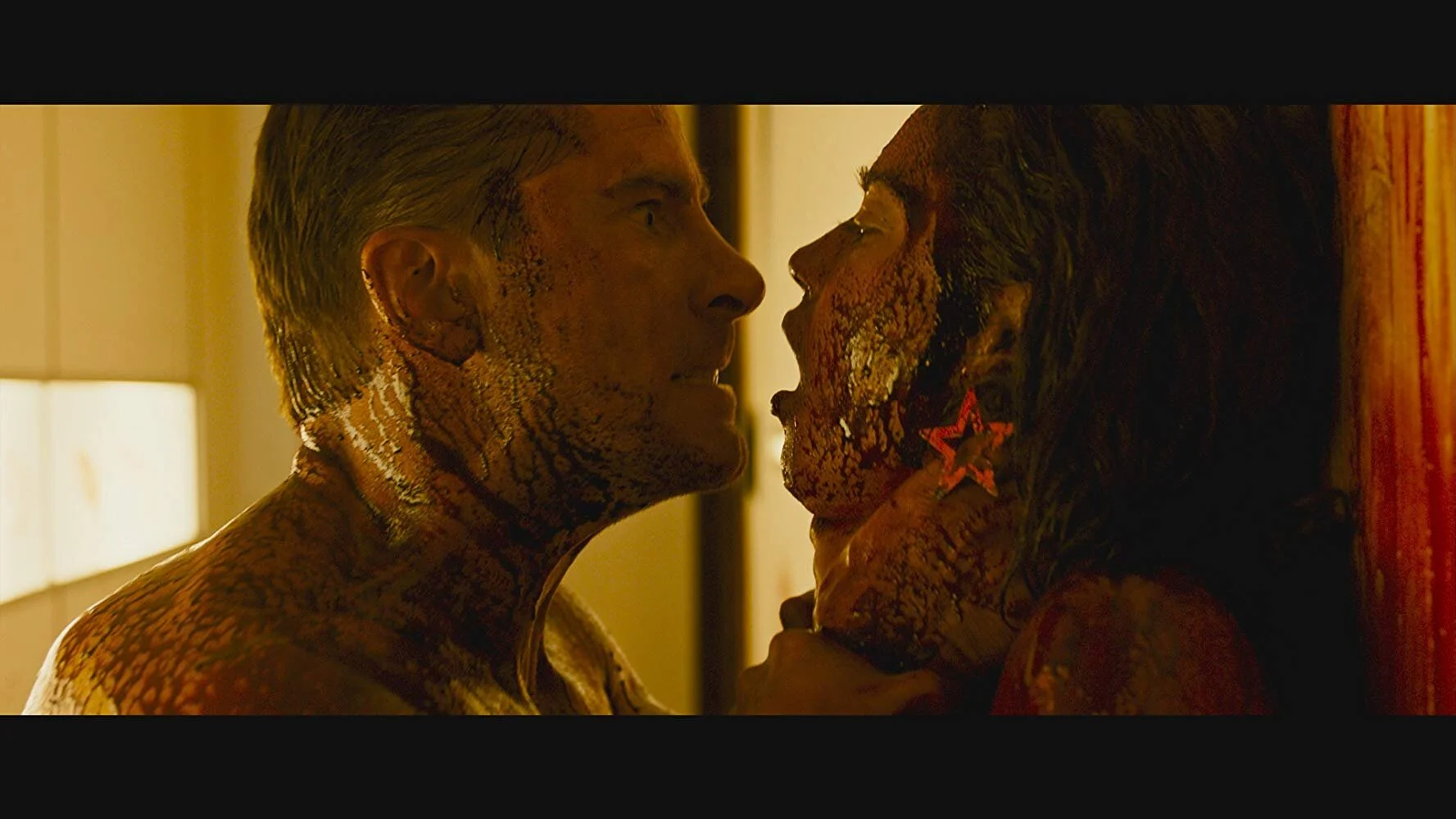
Then again, she's not the only one who's objectified. The final showdown was always going to be between Jen and Richard, who underestimates her to the end, with him insisting he and his friends split up even when they discover Dimitri's body. He is also naked throughout their confrontation, and Fargeat's camera is like a voyeur, lingering behind Richard and emphasizing his vulnerability for the end we know is coming, and which leaves his immaculate home smeared with blood on nearly every surface, with his ultimate insignificance emphasized.

Neither Jen or Fargeat gives these men any mercy. They're all married, but their families only serve to emphasize their coldness and entitlement. They're all held equally responsible for Jen's suffering, and they all pay the price for their vicious misogyny. There is no voiceover, no running dialogue of Jen's mind, but Fargeat doesn't need it with an actress like Lutz. Her mostly wordless performance proves that less really can be more, with her journey from sex object to victim, and finally, action heroine, gives us a deeply satisfying, stylish feminist vision bathed in blood.